Bible Games: Trivia & Puzzles
Dove Game StudiosTrivia
4.728.00 Reviews
- Version
- 2.3.1
- Installs
- 100.00K
- Age Rating
- Everyone
Screenshots
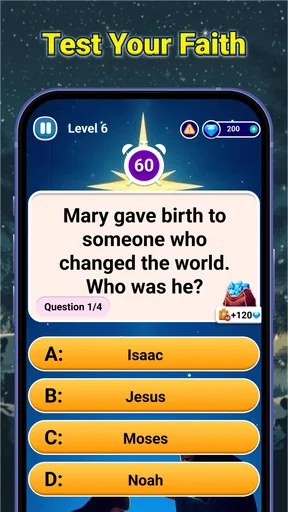
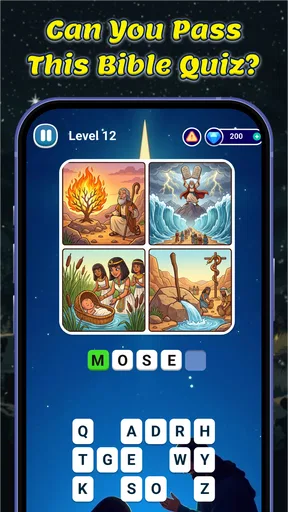
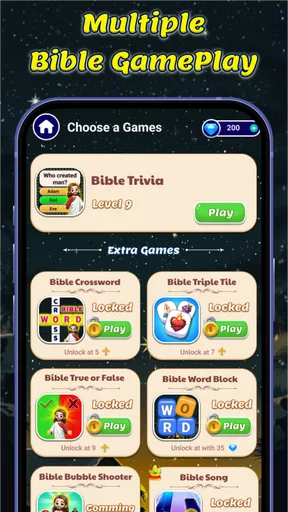
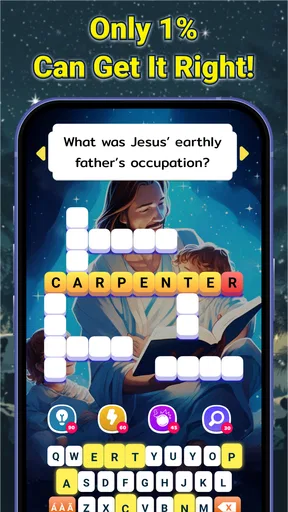
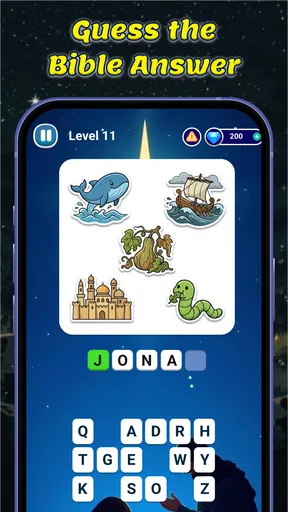
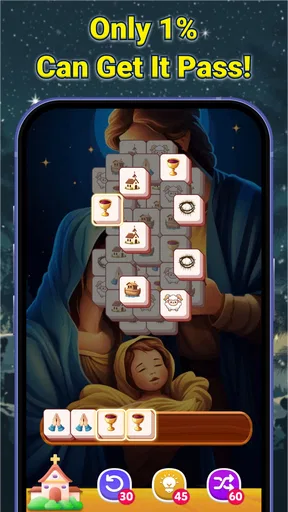
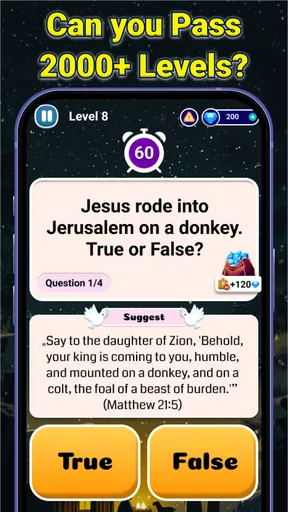
Our Review of Bible Games: Trivia & Puzzles
 Analysis by Appyee
I approached Bible Games: Trivia & Puzzles expecting a simple quiz app, but its broader mix of Bible questions, word games, puzzles, and other Christian-themed activities gives it a different rhythm from a standard trivia title. The most useful capability, in my experience, is the way it turns short moments of spare time into a light, faith-centered challenge without requiring a long session. I can open it for a quick question, stay longer when I want a more relaxed puzzle, and stop without feeling that I have abandoned a complicated game.
That flexibility is the reason I would recommend it to someone who wants entertainment connected to biblical knowledge rather than a general-purpose quiz. It is a free trivia game from Dove Game Studios, rated 4.7 on average from around 2.4 thousand ratings, with more than 100 thousand installs. Those figures suggest that it has found an audience, but they do not replace the more important question: whether its particular style fits the way you like to learn, play, or spend a few quiet minutes.
A Bible trivia experience built around short, repeatable challenges
I look at the game’s opening appeal through the small goals it offers: answer a Bible question, try a different activity, or use a spare moment for a themed puzzle. That low-pressure starting point suits casual play better than a long lesson, especially when I want to invite someone else in without asking them to commit to a full study session. From there, the more useful question is how play signals progress beyond simply getting an answer right.
The central capability: turning knowledge into several kinds of play
The strongest idea here is not simply that the game asks questions about the Bible. It is that the same subject can be approached through different forms of play. A direct trivia question tests recall. A word activity makes me look at familiar religious vocabulary from another angle. A puzzle slows the pace and asks for attention rather than an instant answer. That change of format matters because repeated multiple-choice questions can become tiring, even when the subject is meaningful to the player.
I found this especially helpful when my concentration was uneven. If I was in the mood to test what I remembered, trivia made sense. If I wanted something calmer, a word or puzzle activity felt less like an examination. The Christian focus remains consistent, while the mental effort changes. The practical benefit is variety without leaving the subject behind.
This makes the app more approachable for families, church groups, and individual players who want a casual way to revisit biblical names, events, teachings, and terminology. It is not trying to replace a study Bible or a structured lesson. Instead, it creates a playful doorway into the material. That distinction is important: the game can encourage curiosity and recall, but a player who wants detailed context will still need another source alongside it.
The app is listed for Everyone, which matches its generally accessible concept. I would still use some judgment with younger children, not because the basic idea is unsuitable, but because the value of a question depends on whether a child understands the wording and the subject. With a parent, teacher, or older sibling nearby, an incorrect answer can become a useful conversation rather than just a missed point.
What changes when trivia is mixed with puzzles
In an ordinary trivia app, the main loop is often predictable: read, choose, receive a result, and continue. That format is convenient, but it can make the experience feel like a test. Here, the presence of puzzles and word games gives me more control over the kind of attention I want to use. I can treat the app as a quick memory check or as a gentler brain break with a Christian theme.
That difference also affects replay value. A question I already know may have limited interest when presented in exactly the same way. A word challenge can still be enjoyable because it asks me to manipulate or recognize information rather than merely retrieve it. Conversely, players who enjoy the competitive feeling of rapid-fire quizzes may find the slower activities less exciting. The app’s flexibility is a strength, but it means the experience will not feel equally satisfying in every mode.
I would describe the tone as more reflective and casual than competitive. Someone looking for a leaderboard-driven contest, elaborate character progression, or a visually demanding adventure should probably choose a different kind of game. This title earns its place through accessibility and theme, not through spectacle.
How I use it in ordinary daily moments
The best everyday use case is a short waiting period: a few minutes before an appointment, a quiet break during the day, or a relaxed moment after dinner. I can begin with a couple of questions instead of committing to a full play session. If the questions spark a memory or a discussion, I can continue with a puzzle. If I am distracted, I can stop without losing the point of having opened the app.
Another realistic scenario is a small family activity. One person can read a question aloud while others answer together, and the different game types help avoid making the evening feel like a formal lesson. A group could pause after an unfamiliar answer and discuss the passage or person involved. The app itself supplies the prompt, while the conversation supplies the deeper value.
For personal use, I would keep a simple note of questions that exposed gaps in my memory. I would not treat a wrong answer as proof that the app has taught me the complete explanation. Instead, I would use it as a signal to look up the relevant chapter or topic later. This workflow turns casual play into a modest study aid: play first, identify weak areas, then read more carefully elsewhere.
How it works in practice for different levels of knowledge
A player with a strong background in the Bible may find the basic questions comfortable, especially when familiar people, stories, or terms appear. That can make the app relaxing, but it may also reduce the challenge if the player expects advanced interpretation or detailed historical context. I would approach it as a recall and recognition game rather than a specialist examination.
For someone who is still learning, the experience can be more useful, but patience matters. Guessing may produce a correct result without real understanding, while an unfamiliar term may feel frustrating if the player does not know where it comes from. My advice is to slow down, read every option, and treat mistakes as prompts for further reading. The game is at its best when it encourages that habit rather than becoming a race to tap an answer.
It can also work for someone who is curious about Christian culture but does not consider themselves deeply familiar with the Bible. The themed format gives that person a clear starting point. However, I would not recommend relying on any quiz app as the sole way to learn a religious text. Short questions necessarily simplify complicated subjects, and a single answer rarely provides the surrounding context that makes a passage meaningful.
Useful habits that make the experience better
One practical approach is to alternate modes instead of staying with the easiest activity. Trivia is useful for checking immediate recall, while word games can reveal whether I recognize the terms when they are presented in a less direct form. Moving between them makes the session feel less repetitive and gives a more honest impression of what I actually remember.
A second habit is to avoid playing while rushing. The attraction of a short-session game is that it fits into spare time, but hasty tapping can turn a knowledge exercise into guesswork. When I give myself a moment to compare the choices, the result feels more useful. This is particularly important when several answers sound familiar.
A third is to use the game as a conversation starter rather than a final authority. In a family or group setting, an answer can lead to questions such as where an event appears, why a person matters, or how different passages connect. That approach gives the app a role it handles well: opening a topic without pretending to provide an entire lesson.
The tradeoff between accessibility and depth
The same simplicity that makes the game easy to pick up can limit it for experienced players. A person seeking verse-by-verse explanation, scholarly background, denominational comparison, or a carefully organized study plan will probably be better served by a dedicated Bible study application or a printed study resource. This game is more suitable as a companion to those tools than as a replacement.
There is also a difference between entertainment and retention. I may remember that I missed a question, yet still forget the underlying detail later. To get more from the app, I would connect each mistake to a follow-up reading session. Without that extra step, the game remains enjoyable but may not produce lasting learning.
The variety of activities can reduce repetition, but it cannot eliminate it completely. Players who dislike quiz formats, word challenges, or puzzle solving will not suddenly enjoy them because the theme is biblical. Likewise, someone who wants a completely offline, distraction-free reading experience may prefer opening a Bible or a book instead. This app is designed for active participation, not quiet text study.
In-app purchases range from less than a dollar to nearly fifty dollars per item. That makes it worth paying attention to spending habits, particularly when children use the device. The app itself is free, which lowers the barrier to trying it, but free entry does not mean every optional purchase will suit every player. I would begin without buying anything and decide only after understanding how much I genuinely use the available activities.
How it compares with familiar alternatives
Compared with a general trivia app, this game offers a much narrower subject but a clearer identity. A broad quiz title may provide more variety across science, entertainment, geography, and history. That is the better choice for someone who wants unpredictable general knowledge. Bible Games: Trivia & Puzzles is preferable when the theme itself is the reason to play.
Compared with a Bible reading app, the difference is even more pronounced. A reading app is built around access to text, searching, highlighting, plans, and sustained study. This game is built around prompts, answers, and playful interaction. If I want to understand a passage in context, I would choose the reading tool. If I want to test what I remember or invite someone else into a quick activity, this game is more natural.
Compared with a classroom quiz or church worksheet, it is more convenient for spontaneous use and less formal. A teacher or group leader may appreciate the easy starting point, but should add explanation rather than treating each response as the entire lesson. The app can provide an engaging opening exercise; a human guide is still better at handling nuance, questions, and different levels of understanding.
Who gets the most from this game
The best audience is someone who already enjoys short trivia sessions and wants the content to reflect Christian interests. It also suits families looking for a shared activity that is easier to begin than a long board game. People returning to Bible study may appreciate the low-pressure way to identify familiar and unfamiliar topics.
It is particularly useful for players who become bored with a single question format. The combination of trivia, word games, and puzzles gives them a reason to change pace while keeping a consistent theme. That is the app’s most convincing advantage over a basic Bible quiz: it offers more than one way to engage with the same broad subject.
I would be more cautious about recommending it to advanced students who want rigorous detail, players who need a serious competitive system, or anyone who dislikes in-app purchase structures. Those users may find a specialized study resource, a general knowledge game, or a traditional group activity more satisfying.
Device details and what to expect from the current release
The game was released on December 8, 2024, and the current version is 2.3.1. It supports devices running Android 7.1 or later, so people using older phones should check compatibility before planning to install it. The age rating is Everyone, and the basic download is free, making it straightforward to test without an initial payment.
Those details make the app relatively approachable, but the real decision still comes down to expectations. This is not a substitute for reading scripture carefully, and it is not a high-intensity action game. Its value comes from combining a familiar religious theme with compact, repeatable activities that can fit around a normal day.
My final recommendation
I recommend Bible Games: Trivia & Puzzles to anyone who wants a friendly way to revisit Bible knowledge, start conversations, or fill short breaks with something more purposeful than a generic quiz. I especially like the central choice between direct trivia and less test-like word or puzzle activities. That choice makes the experience easier to return to when my energy or attention changes.
I would install it with a clear understanding of its limits. Use it for recall, enjoyment, and discussion; use a Bible or study resource for context and depth. Start with the free experience, avoid rushing through answers, and turn mistakes into subjects for later reading. For casual Christian learning, its best feature is not that it answers every question, but that it gives me a simple reason to ask better ones.
Verdict
Strengths of Bible Games: Trivia & Puzzles
- Covers Bible facts from both the Old and New Testaments.
- Short rounds make it easy to play during quick breaks.
- Puzzle variety keeps the experience from feeling repetitive.
- Helpful for families seeking faith-based educational entertainment.
- Simple interface is accessible for younger and older players.
Limitations of Bible Games: Trivia & Puzzles
- Some questions may depend on a specific Bible translation.
- Difficulty can vary noticeably between consecutive rounds.
- Repeated questions may reduce the challenge over extended play.
- Progress may feel slow without spending time on daily challenges.
- Requires careful reading, as similar biblical names can cause confusion.
Similar Picks in This Category
View All
Millionaire 2026 Quiz & Trivia
Quiz & Trivia Games by Submarine Apps4.5

Brain Test 2: Tricky Stories
Unico Studio4.7

Trivia Crack: Brain Quiz Games
etermax4.4

QuizzLand. Quiz & Trivia game
Quiz & Trivia Games by Mno Go Apps4.8

Brain Test: Tricky Puzzles
Unico Studio4.7

Logo Quiz
bubble quiz games4.5
Frequently Asked Questions
What is Bible Games: Trivia & Puzzles?
Bible Games: Trivia & Puzzles is a faith-based mobile game that combines Bible trivia with puzzle-style challenges. It is designed for players who want to test their knowledge of Scripture in a more interactive format. Questions may cover biblical people, events, books, teachings, and well-known passages, making it suitable for casual play, learning, or family entertainment.
Is Bible Games: Trivia & Puzzles suitable for beginners or people unfamiliar with the Bible?
Yes. The game can be enjoyed by both experienced Bible readers and beginners. Players who do not know every answer can use the questions as a learning opportunity and gradually become familiar with important biblical stories and characters. However, the difficulty may vary between challenges, so some rounds could feel demanding if you are new to Scripture-based content.
Does Bible Games: Trivia & Puzzles require an internet connection?
An internet connection may be needed for certain features, such as downloading the game, displaying advertisements, synchronizing progress, or accessing updated content. Some basic challenges may work offline, but availability can depend on the version installed and the device being used. It is best to open the game while connected before relying on it during travel or without mobile data.
Are there advertisements or in-app purchases in Bible Games: Trivia & Puzzles?
The game may include advertising and optional in-app purchases, depending on the platform and current version. Advertisements can appear between rounds or when using certain bonus features, while purchases may offer hints, remove ads, or provide other conveniences. Before downloading, review the store listing and your device’s purchase settings, especially if children will be playing.
Can children play Bible Games: Trivia & Puzzles safely?
Bible Games: Trivia & Puzzles is generally designed around educational, religious, and family-friendly content, which can make it appropriate for children. Nevertheless, parents should check the current age rating, advertising policy, privacy information, and any online or purchase features. If a child uses the app, parental controls are recommended to prevent accidental purchases or interaction with external content.
Play our best games!


